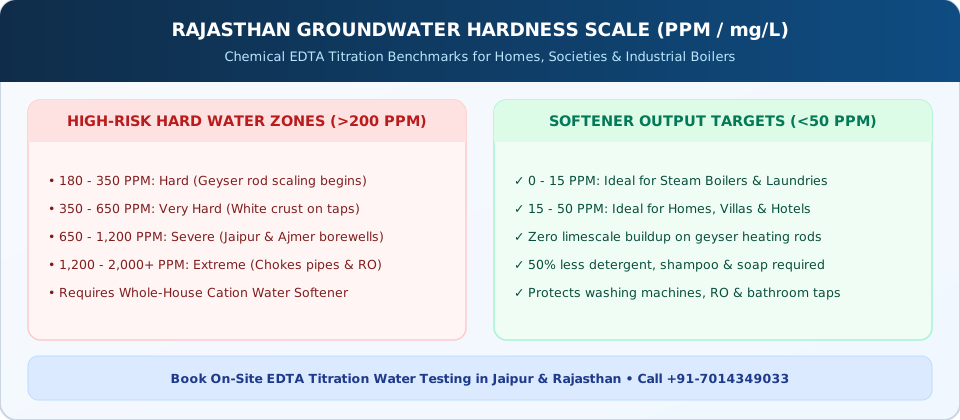
"When we run EDTA titration tests on borewells in Jaipur's Jhotwara, Kalwar Road, and Sikar Road sectors, we often find a 60:40 split between Calcium hardness and Magnesium hardness. While calcium creates the chalky white crust on geyser heating coils, high magnesium is what gives raw tube-well water a slightly bitter metallic aftertaste and forms a greasy, sticky ring around bathroom buckets."
The Chemical Similarities
Calcium (Ca) and Magnesium (Mg) are alkaline earth metals located in Group 2 of the periodic table. In water, both exist as divalent cations, meaning they carry a double positive charge (Ca²⁺ and Mg²⁺). Because of their high charge density, they readily react with other elements in water, particularly carbonates, sulfates, and fatty acids, causing water hardness.
Key Differences in Scale Behavior
Although they are grouped together as hardness minerals, they exhibit distinct crystallization patterns:
- Calcium Scaling (Calcite/Aragonite): Calcium forms the bulk of limescale. It precipitates easily as calcium carbonate (CaCO₃). Calcite is rock-hard, crystalline, and attaches firmly to metallic surfaces, especially heating elements. It acts as an insulator, reducing heat transfer and damaging components.
- Magnesium Scaling: Magnesium precipitates as magnesium carbonate (MgCO₃), magnesium hydroxide (Mg(OH)₂), or magnesium silicate. Magnesium scale is generally softer and more powdery than calcium scale, but when combined with silicates, it forms an extremely tough, glassy barrier that is very difficult to dissolve.
Health & Dietary Aspects
Both calcium and magnesium are essential minerals for human health. Calcium is vital for bone density and muscle function, while magnesium supports enzyme activity and cardiovascular health. However, drinking hard water is not an efficient way to meet your daily intake, as these inorganic minerals are poorly absorbed by the body compared to organic minerals found in food.
On the skin and hair, both minerals cause severe dryness. They react with soap to form insoluble scum that clogs pores, dries out the scalp, and leads to skin irritation and hair breakage. Softening water eliminates these negative impacts by replacing both ions with harmless sodium.
How They Are Removed in Softening
During the ion exchange softening process, the cation exchange resin does not distinguish between calcium and magnesium. Since both carry a divalent positive charge, they are attracted to the negative sulfonic groups on the resin beads, displacing the weakly bound monovalent sodium (Na⁺) ions. Both minerals are trapped on the resin and eventually flushed down the drain during regeneration.
Anjani Traders provides advanced whole-house water softeners that efficiently remove both calcium and magnesium, ensuring completely soft water for your home.
Calcium vs. Magnesium Distribution in Rajasthan Borewells
Across Jaipur, Ajmer, and Jodhpur, the ratio of calcium to magnesium depends heavily on local rock geology. Borewells drilled into limestone (such as in Jagatpura or Kota) are dominated by Calcium Bicarbonate, whereas tube-wells in dolomitic belts (Kishangarh, Jhotwara, and Bikaner) carry high Magnesium Sulfate and Magnesium Chloride.
From an engineering standpoint, strong-acid cation exchange resin (such as 225 Na food-grade beads) has a slightly higher selectivity for divalent Calcium (Ca2+) than Magnesium (Mg2+). This means when your softener approaches exhaustion at the end of the week, magnesium ions are the first to slip past the resin bed. Regenerating on schedule using 99.7% pure compacted salt tablets (₹500 / 25kg bag) ensures high brine osmotic pressure that strips both calcium and magnesium completely from the resin matrix.
Frequently Asked Questions
Request Softener Support
Connect with Anjani Traders on WhatsApp for prompt service, salt delivery, or expert advice in Jaipur.