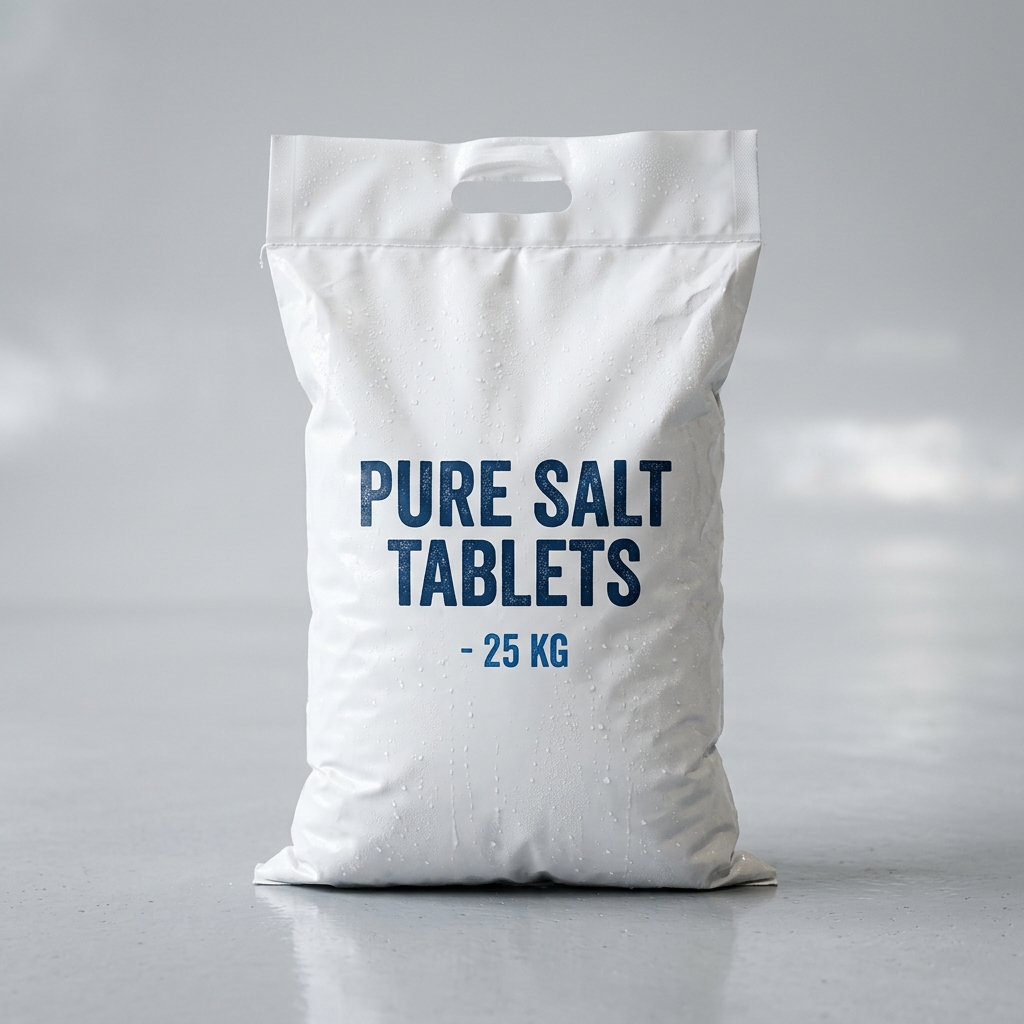
How Does a Water Softener Use Salt?
Many people believe that salt is added to water softeners to soften the water directly. In reality, the salt plays a vital role behind the scenes. Inside a water softener, hard minerals (calcium and magnesium) are captured by millions of microscopic plastic beads coated in sodium ions. This process is called ion exchange.
Over time, these beads become fully saturated with calcium and magnesium and lose their capacity to soften water. This is where the salt comes in. During a cycle called regeneration, the system flushes a highly concentrated saltwater solution (brine) through the resin tank. The sodium ions in the brine force the calcium and magnesium minerals off the resin beads, washing them down the drain. The resin is then replenished and ready to soften water again.
Comparing Water Softener Salt Types
Using the wrong type of salt can cause major operational issues. Let's compare the three most common salt types available in the Indian market:
| Feature | Compacted Tablets (Recommended) | Rock Salt / Crystal Salt | Common Table / Fine Salt |
|---|---|---|---|
| Purity Level | 99.7% NaCl (Certified) | 95% - 98% NaCl (High Dirt) | 97% - 99% NaCl (With Additives) |
| Dissolution Rate | Uniform & Gradual | Irregular & Uneven | Too Fast (Instant) |
| Residue / Dirt | Zero Residue | High Sand/Clay particles | Chemical Additive Film |
| Resin Bed Protection | Excellent (Extends life by 5-8 yrs) | Poor (Coats/Clogs resin beads) | Dangerous (Poisons resin) |
| Mushing/Bridging Risk | Very Low | Medium | Extremely High |
Typical Refinery Batch Chemical Analysis (COA Benchmark)
For industrial boiler engineers, hospital CSSD managers, and hotel chief engineers, here is our standard vacuum-evaporated compacted salt tablet analytical profile (tested per IS 797 / Food & Industrial Brine Standards):
| Analytical Parameter | Test Method / Standard | Guaranteed Limit | Typical Batch Result |
|---|---|---|---|
| Sodium Chloride (NaCl) on Dry Basis | IS 797 / Argentometric Titration | 99.50% Min | 99.74% |
| Water Insoluble Matter (Sand/Silt) | Gravimetric Filtration | 0.02% Max | 0.008% (Residue-Free) |
| Moisture Content | Loss on Drying (110°C) | 0.10% Max | 0.03% |
| Calcium (as Ca2+) / Magnesium (as Mg2+) | EDTA Complexometric | 0.06% Max | 0.03% / 0.01% |
| Hydraulic Compaction Density & Shape | Mechanical Crush Test | >2.10 g/cm³ | 2.16 g/cm³ Pillow Briquette (25×16mm) |
Why Low-Purity Salt Damages Your Softener
Buying cheap, unrefined salt might seem cost-effective initially, but it leads to severe long-term complications:
- Salt Bridging: A hard crust forms across the brine tank, creating empty space between the salt and the water. The water cannot dissolve the salt, preventing regeneration, resulting in untreated hard water.
- Salt Mushing: Salt recrystallizes at the bottom of the tank into a thick, paste-like mush. This prevents the brine from flowing, blocks valves, and requires manual tank draining and cleaning.
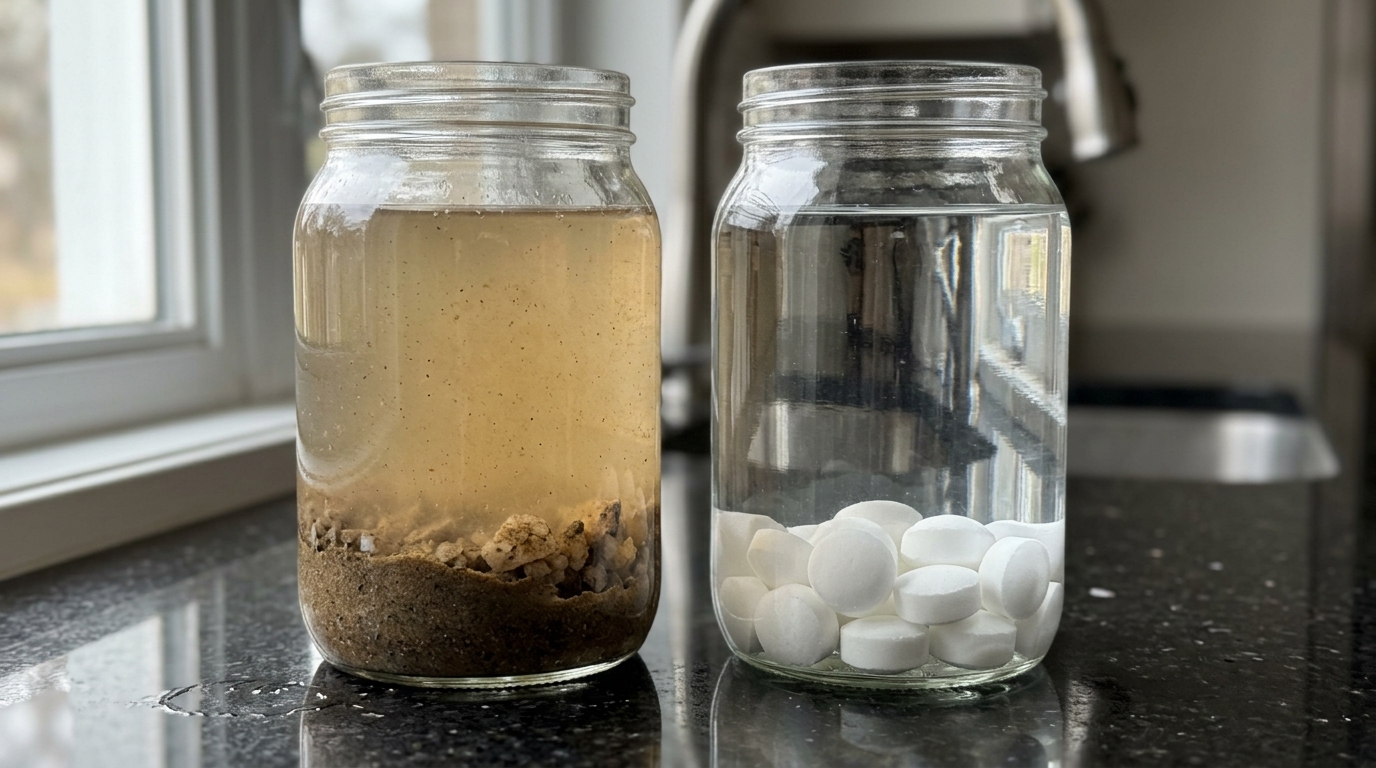
- Resin Fouling: Clay, sand, and heavy metal impurities in unrefined salt coat the outer layer of the exchange resin. Once coated, the resin cannot absorb minerals and must be replaced.
💡 Sourced Directly From Gujarat Factory
Our premium compacted salt tablets are produced at our state-of-the-art facility in Gujarat using food-grade evaporated salt. Because you buy directly from the manufacturer through Anjani Traders, you get these certified 99.7% pure tablets at a very cheap price with zero middleman margins.
Get a Quote / Order
Fill out the details below to buy directly from our Jaipur depot. We will redirect you to WhatsApp.