"Whenever we visit an Apartment Residents' Welfare Association (RWA) meeting in Jaipur, we don't bore the committee members with chemical charts. We put two clear 500ml plastic bottles on the table—one filled from their society guard-room tap, and one filled from our softened demo canister—add 4 drops of soap to each, and ask the society president to shake both. The visual difference convinces the entire room in 10 seconds."
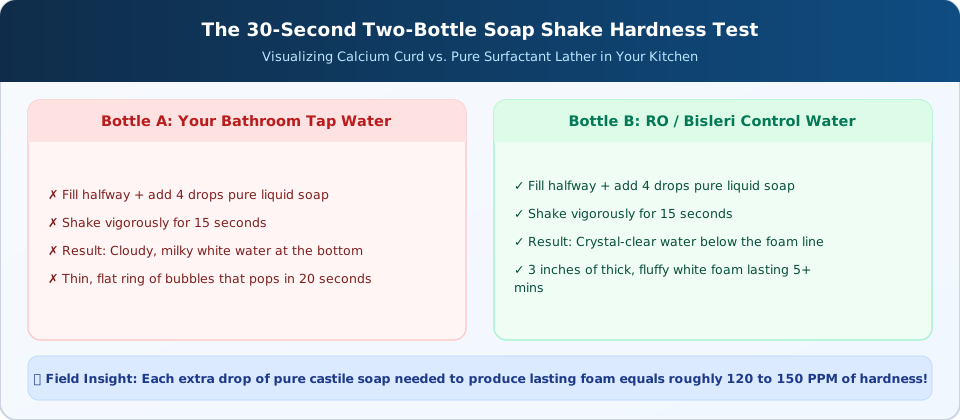
How to See Your Water Hardness with Your Own Eyes Right Now
You don't need a laboratory report to prove whether your home's borewell water is ruining your appliances—or to check if your existing water softener has run out of regeneration capacity. All you need are two identical empty 500 ml clear plastic water bottles and basic liquid handwash or dish soap.
Step-by-Step Instructions: The Two-Bottle Shake Test
- Prepare the Control Bottle (Bottle A): Fill the first bottle halfway (250 ml) with drinking RO water or a ₹20 bottle of Bisleri/Kinley mineral water.
- Prepare the Test Bottle (Bottle B): Fill the second bottle halfway (250 ml) with water straight from your bathroom tap or geyser outlet.
- Add Exactly 4 Drops of Soap: Put 4 drops of pure liquid soap (or Vim drop dishwash / liquid handwash) into both bottles. Screw the caps on tightly.
- Shake for 15 Seconds & Place Side-by-Side: Shake both bottles hard for 15 seconds, set them on your kitchen counter, and look at two things: the height of the top foam and the clarity of the water underneath.
How to Read Your Results
- Soft Water (<50 PPM): The top half of the bottle fills with dense, shaving-cream-like white suds that stay standing for 5+ minutes, and the liquid water at the bottom remains crystal clear.
- Moderately Hard Water (200–400 PPM): You get less than an inch of weak bubbles that fizzle out quickly, and the water below looks slightly hazy like diluted milk.
- Severe Rajasthan Borewell Hardness (600–1,500+ PPM): Almost zero foam forms! Instead, all 4 drops of soap instantly react with calcium to turn the water cloudy grey-white with greasy white curd floating at the waterline. Keep adding soap 2 drops at a time and shaking until a lasting foam finally appears—if it takes 16 drops instead of 4, you are wasting 400% more soap and detergent in every shower and laundry load!
Want an exact numeric PPM reading for your home? Use our Water Softener Size Calculator or message our Jaipur team on WhatsApp to schedule a professional EDTA Titration Water Hardness Test at your doorstep.