"At least twice a week, a new client in Jaipur or Ajmer tells us: 'A local hardware shop sold me a ₹180 sack of raw crystal salt (kachcha namak / phoda namak) for my ₹45,000 automatic water softener, and now the brine drum is full of brown mud and the digital valve is jammed!' Saving ₹300 on unrefined crystal salt ends up costing ₹4,500 in technician visits, valve repairs, and fouled resin."
The Crucial Role of Salt in Softening
Water softeners do not filter out water hardness permanently using a physical filter membrane; instead, they exchange ions. When the internal cation exchange resin is saturated with calcium and magnesium, it must be recharged with sodium. This sodium is supplied by dissolving salt in the brine tank. Choosing between compacted salt tablets and raw crystal salt is the single most important maintenance decision you will make.
Raw Crystal Salt: The Cheap But Risky Choice
Raw crystal salt (rock salt or uncompacted solar salt) is naturally mined salt that has not undergone refinement. While it is inexpensive, it contains significant impurities such as dirt, sand, insoluble minerals, and sulfate traces. These impurities cause severe issues in a water softener:
- Salt Mushing: Raw crystal salt dissolves unevenly and tends to collapse into a thick, muddy sludge at the bottom of the brine tank. This sludge blocks the brine draw tube and prevents the system from drawing saltwater during regeneration.
- Salt Bridging: A hard crust forms across the middle of the brine tank, leaving an empty space underneath it. The water cannot reach the salt to dissolve it, which means no brine is formed, and the softener outputs hard water despite the tank looking full of salt.
- Valve & Injector Clogging: Dirt and sand present in raw salt can easily enter the control valve, scratching the internal rotor discs or clogging the micro-injectors, leading to costly technician service calls.
Compacted Salt Tablets: The Gold Standard
Premium water softener salt tablets are made from vacuum-refined salt compacted under high hydraulic pressure into pillow-shaped tablets. They boast a chemical purity of 99.7% Sodium Chloride (NaCl). Here is why they are superior:
- Uniform Dissolution: Because of their uniform density and pillow shape, they dissolve slowly and evenly from the outside in, preventing any salt mushing or bridging.
- Zero Sediment: High refinement means there is no sand, silt, or mud left in the brine tank. Your brine tank remains clean, and the micro-valves are protected from abrasion.
- Long-Term Cost Savings: Preventing valve damage, saving resin from fouling, and avoiding regular tank cleanings easily offsets the slightly higher initial cost of tablets.
Comparison Summary
| Parameter | Compacted Salt Tablets | Raw Crystal Salt |
|---|---|---|
| Chemical Purity | ~99.7% pure NaCl | 95% - 98% with silt & sulfates |
| Risk of Salt Mushing | Extremely Low | High (Forms clay-like sludge) |
| Risk of Salt Bridging | Minimal | High (Crust formation) |
| System Lifetime Impact | Extends valve and resin life | Can clog injectors and damage seals |
| Relative Cost | Slightly higher per kg | Very cheap upfront |
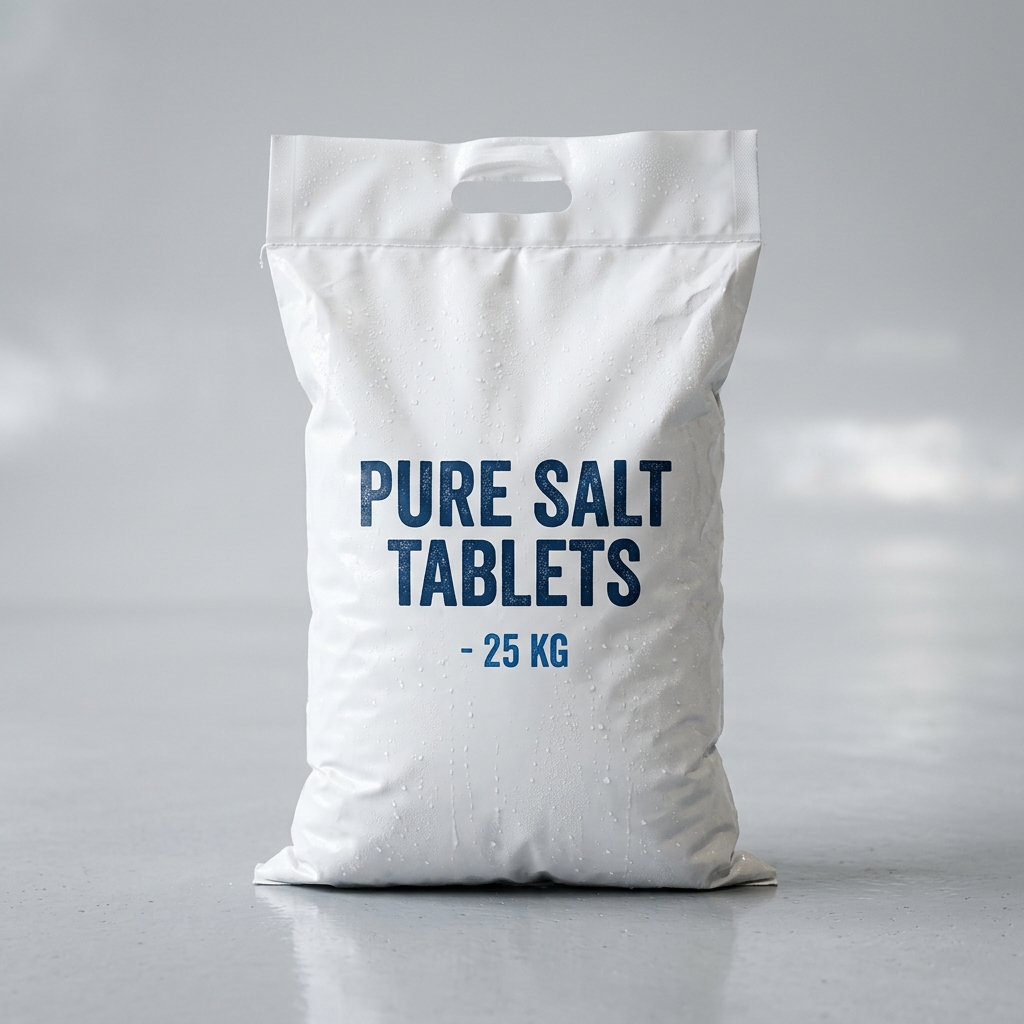
Anjani Traders supplies high-density, double-compacted salt tablets sourced directly from premium refineries in Gujarat. Available at a highly competitive price of ₹500 per 25kg bag, we offer prompt delivery to residences, apartments, hotels, and industrial sites across Jaipur.
Laboratory & Field Breakdown: Why 99.7% Pure Briquettes Win Every Time
Whether you operate a compact 3M / Kent / Zero B cabinet softener in a bungalow or a 500-liter FRP plant in a Sitapura factory, the difference between hydraulic-compacted pillow tablets and raw crystal/rock salt comes down to three measurable metrics:
- <0.01% Insoluble Matter vs. 4–6% Sand/Mud: Raw crystal salt scraped from open solar pans contains desert silt, clay, and gypsum. Over 10 bags (250 kg), that equals 10 to 15 kg of wet mud dumped directly into your brine tank! Our Gujarat refinery vacuum-evaporated tablets are 99.7% pure NaCl.
- High-Pressure Hydraulic Compaction: Loose crystals dissolve unevenly and collapse into a wet paste ("mushing") at the bottom of the drum or crust into a hollow salt bridge. Our pillow briquettes dissolve uniformly from the bottom up without losing their shape.
- Factory-Direct Value: At ₹20/kg (₹500 per 25kg bag) with Free Jaipur delivery on 20+ bags, our compacted tablets protect your resin bed for 8–10 years.
Frequently Asked Questions
Request Softener Support
Connect with Anjani Traders on WhatsApp for prompt service, salt delivery, or expert advice in Jaipur.