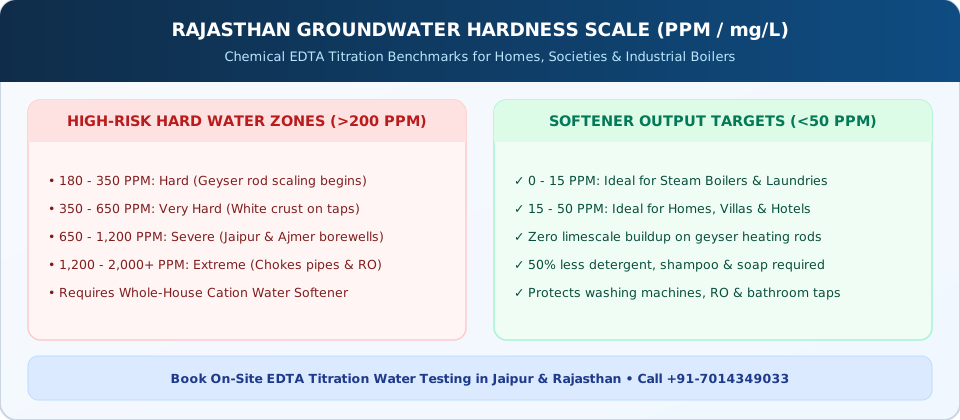
"When international water softener manuals written in the US or Europe label 180 PPM as 'Very Hard Water,' our Jaipur technicians can't help smiling. In Jaipur's Jagatpura, Sirsi Road, and Sitapura—as well as Jodhpur, Bikaner, and Kishangarh—borewell water routinely starts at 500 PPM and climbs past 1,600 PPM! Sizing a softener in Rajasthan using standard textbook assumptions guarantees an undersized system."
Units of Water Hardness
Water hardness is expressed in various scientific and industrial units. The three most common units are:
- Parts Per Million (PPM): One part of calcium carbonate equivalent per million parts of water. It is identical to Milligrams Per Liter (mg/L), which is the standard metric unit used in laboratory chemical reports across India.
- Grains Per Gallon (GPG): An imperial unit predominantly used in sizing American water softeners. One grain (64.8 mg) of calcium carbonate dissolved in one US gallon (3.785 liters) of water.
- German Degrees (°dH): Primarily used in European technical manuals. One °dH corresponds to 10 mg of calcium oxide (CaO) per liter of water.
How to Convert Units
To convert between these units when setting up an automatic metered valve (which often requires input in GPG or PPM), use the following formulas:
PPM (mg/L) to GPG: Divide PPM by 17.1 (e.g., 342 PPM ÷ 17.1 = 20 GPG)
GPG to PPM: Multiply GPG by 17.1 (e.g., 15 GPG × 17.1 = 256.5 PPM)
PPM to °dH: Multiply PPM by 0.056
The Water Quality Association (WQA) Classification
The WQA classifies water hardness based on the potential for scale formation and soap interference:
| Hardness Class | PPM (mg/L) | GPG | Action Required |
|---|---|---|---|
| Soft | 0 - 17.1 | 0 - 1.0 | None |
| Slightly Hard | 17.2 - 60 | 1.0 - 3.5 | Generally none |
| Moderately Hard | 60 - 120 | 3.5 - 7.0 | Recommended for geysers |
| Hard | 120 - 180 | 7.0 - 10.5 | Water Softener needed |
| Very Hard | 180+ | 10.5+ | Critical. Softener mandatory |
Rajasthan Groundwater Reality
In Jaipur and other parts of Rajasthan, the municipal supply or borewell groundwater routinely shows hardness values between 400 PPM and 1,500 PPM. Using this water without treatment causes rapid scaling, low pressure, skin issues, and heavy chemical costs. If your water exceeds 120 PPM, installing a water softener will protect your plumbing investment.
Contact Anjani Traders today to schedule a water test. We will measure your hardness and recommend a perfectly sized softener for your home.
Colony-Wise Jaipur & Rajasthan Hardness Benchmarks (2026 Field Data)
Based on hundreds of on-site EDTA titration drop tests conducted by Anjani Traders across Rajasthan, here is how local water supplies actually measure up (see also our Bisalpur vs. Borewell Hardness Report):
- Pure Bisalpur Pipeline Supply (120 – 180 PPM): Moderately hard; causes slow tap spotting over months, but often mixed 50:50 with society borewells.
- Central & South Jaipur Borewells (Malviya Nagar, Bani Park, C-Scheme): Typically 450 – 850 PPM. Requires a 25L–50L whole-house softener regenerating every 6–7 days.
- Extreme Hardness Zones (Jagatpura, Mansarovar Ext, Kishangarh, Jodhpur, Bikaner): Routinely 850 – 1,800+ PPM. Requires high-capacity FRP vessels (50L–100L+ resin) and pure 99.7% compacted salt tablets (₹500 / 25kg bag).
Plug your colony's PPM reading into our Water Softener Size Calculator to see your exact resin volume and salt dosage.
Frequently Asked Questions
Request Softener Support
Connect with Anjani Traders on WhatsApp for prompt service, salt delivery, or expert advice in Jaipur.