"Last Tuesday in Malviya Nagar, a homeowner called us saying he hadn't needed to buy salt for four months because his brine tank stayed full! He thought his softener had become super-efficient. In reality, his venturi injector screen was plugged with a tiny flake of teflon tape and silt. For four months, the timer ran at 2 AM, but zero brine was sucked in—his family had been bathing in 100% raw hard water."
How Your Softener Sucks Brine Without a Dedicated Brine Pump
Have you ever wondered how a water softener pulls heavy salt water uphill out of the brine tank without an electric pump inside the brine drum? It uses Bernoulli's Venturi Principle. Inside the multiport control head, water is forced through a tiny cone-shaped nozzle (the venturi injector) at high velocity, creating a vacuum suction zone that pulls concentrated salt brine up through the thin tube.
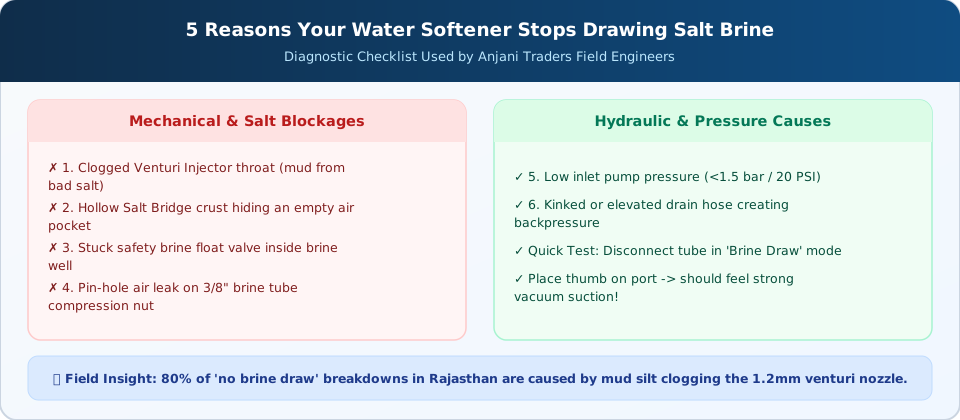
Because that vacuum relies on a nozzle throat only 1.0 to 1.5 mm wide, even a tiny disruption kills the suction completely. If your salt level hasn't dropped in weeks—or water is overflowing out of your brine tank—run through these 5 diagnostic checks in order:
The 5-Step Technician Diagnostic Checklist
- Check #1: Clean the Venturi Injector & Mesh Screen (Most Common): Turn off the inlet valve, release pressure, and unscrew the small round injector cap on the side/top of your multiport valve. Pull out the plastic injector nozzle and tiny mesh strainer. Hold the nozzle up to your phone flashlight—if you cannot see a perfect pinhole of light through the center, poke it clean with a wooden toothpick (never use a steel needle, which enlarges the calibrated hole!) and wash the screen.
- Check #2: Poke the Brine Tank with a Broomstick (Salt Bridge Check): Sometimes the water was sucked out, but low-grade salt caked into a hard roof across the tank, making the tank look full from above. Push a clean wooden mop handle down into the salt; if it crunches through a hollow air cave, you had a salt bridge. Switch to 99.7% pure compacted salt tablets to prevent this permanently.
- Check #3: Inspect the Brine Tube Nuts for Air Leaks: Just like you cannot drink juice through a straw that has a tiny crack in the side, the venturi cannot pull liquid brine if air is leaking past the brass/plastic ferrules at either end of the brine tube. Tighten both nuts snug by hand plus a quarter-turn.
- Check #4: Verify Inlet Water Pressure (>1.5 Bar / 22 PSI): If your softener is mounted right underneath a rooftop overhead tank with only 3 feet of gravity head, water moves too slowly through the venturi to create vacuum suction! A rooftop gravity softener requires a small pressure booster pump upstream to generate proper brine draw.
- Check #5: Ensure the Drain Line Drops Downward: Never run the softener's waste drain hose uphill into an overhead tank or over a high parapet wall. Backpressure on the drain port cancels out the venturi vacuum and pushes water backwards into the brine tank!
Need a professional valve overhaul in Jaipur or Ajmer? Book our Water Softener Repair & Maintenance Service for same-day doorstep diagnostics.