"Two summers ago, a boutique hotel manager near Bani Park decided to save ₹120 per bag by ordering 10 bags of loose 'industrial crystal salt' from a local grocery mandi. Within six weeks, the bottom 8 inches of his 200-liter brine tank turned into thick grey mud. The multiport injector sucked up fine sand, scratched the ceramic control disc, and leaked hard water into his steam boiler."
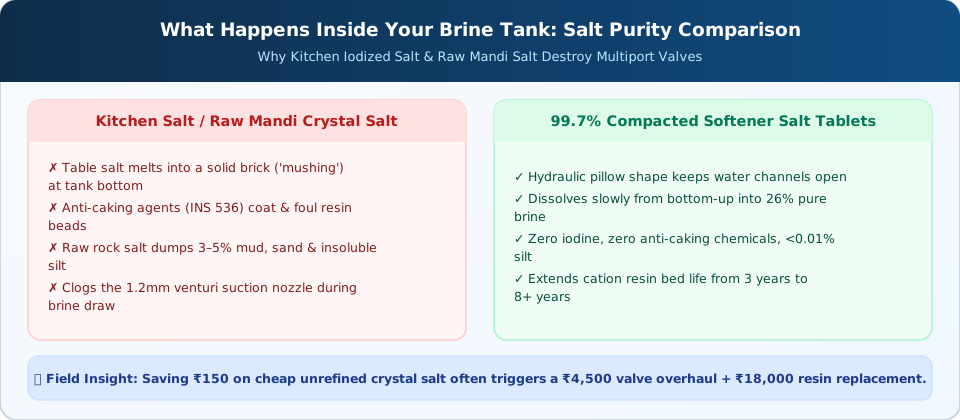
Why Every Salt Is Not Created Equal
Chemically, both kitchen Tata Salt and water softener salt tablets are Sodium Chloride (NaCl). So when the brine tank runs empty on a Sunday morning, it is tempting to grab five 1-kg packets of kitchen salt—or buy a ₹200 sack of raw crystal kachcha namak from the local market—and dump it into your softener.
Don't do it. Not even once. Here is exactly what happens inside your brine tank and resin vessel when you use the wrong salt.
1. Why Fine Kitchen Table Salt Causes "Salt Mushing"
Your brine tank needs water to circulate freely around salt so it can form a saturated 26% brine solution. Because kitchen salt is ground into fine powder, dumping 20 kg of it into standing water causes the grains to pack together like wet beach sand. Water cannot flow between the grains.
Worse, table salt contains Potassium Ferrocyanide (INS 536) or sodium aluminosilicate as anti-caking additives, plus potassium iodate. Those additives do not dissolve neatly in cold brine; they coat the microscopic pores of your expensive polystyrene cation exchange resin, permanently reducing its ion-exchange capacity.
2. Why Raw Rock Salt (Sendha / Mandi Salt) Destroys Valves
Unrefined crystal salt or rock salt contains between 2% and 6% insoluble impurities—gypsum (calcium sulfate), clay, desert sand, and iron oxide. Think about that math: if you put 10 bags (250 kg) of raw salt into your brine tank over a year, you are dumping 7 to 12 kilograms of pure mud and sand straight into your softener!
Inside your softener's multiport valve sits a tiny component called the venturi injector throat, with an opening narrower than a ballpoint pen tip (1.2 mm). The moment sand or clay sludge gets sucked up the brine tube, that injector clogs shut. Your softener continues running its timer cycle, but it draws zero brine—meaning your home gets 100% hard water while you think the machine is working.
How Compacted Salt Tablets Solve Both Problems
Our 99.7% pure vacuum-evaporated compacted salt tablets (₹20/kg, ₹500 per 25kg bag) are compressed under 150+ tons of hydraulic pressure into smooth, pillow-shaped briquettes without a single drop of chemical glue. Because of their rounded geometry, water flows effortlessly between the tablets, dissolving them evenly from the bottom up without mushing, bridging, or leaving mud behind.