"A hospital in Ajmer was quoted ₹42,000 by an out-of-state vendor to dump and replace 300 liters of cation resin that had stopped softening water after just 2.5 years. When our technician pulled a sample of the resin from the top port, the beads weren't cracked—they were simply coated in reddish-brown borewell iron and fine clay. We performed a 2-hour chemical resin wash and extended backwash for a fraction of the cost, bringing outlet hardness right back down to 10 PPM."
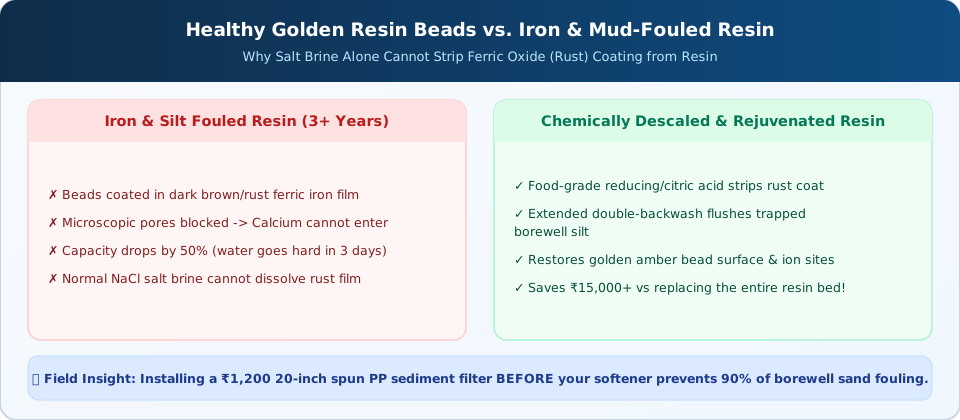
Why Does a Water Softener Lose Capacity Even When It Uses Salt?
High-grade cross-linked polystyrene cation exchange resin is remarkably tough—physically, the golden amber beads can last 6 to 8+ years. Yet many homeowners in Jaipur and Ajmer notice that after 2 or 3 years, a softener that used to give soft water for 7 days suddenly starts giving hard water after just 3 days.
Why? Because while sodium chloride brine (NaCl) easily kicks off Calcium and Magnesium ions, it is chemically too weak to remove oxidized Borewell Iron (Fe3+), Manganese, and colloidal clay silt. Over hundreds of thousands of liters, those impurities form an invisible varnish over the outside of each resin bead, blocking the microscopic doorways where ion exchange happens.
The 3 Signs Your Resin Bed Needs Deep Cleaning (Not Replacement)
- Sign 1 (Shortened Soft Water Days): Your softener still softens water right after regeneration, but the soft water runs out in 3 days instead of 7.
- Sign 2 (Reduced Bathroom Water Pressure): Fine borewell sand and silt from cheap salt have packed into the top 6 inches of the resin bed, acting like a choked plug.
- Sign 3 (Slightly Yellowish Water After Idle Days): Iron trapped on the resin beads leaches out slightly when water sits motionless in the cylinder overnight.
How to Rejuvenate Your Resin Bed in 60 Minutes
- Step 1 (Extended Backwash to Break Channeling): Run two back-to-back 15-minute Backwash cycles to lift and fluidize the resin bed, flushing accumulated borewell sand out the drain port.
- Step 2 (Food-Grade Citric / Phosphoric Resin Cleaner Dosing): Dissolve 150 grams of food-grade citric acid (or specialized iron-out resin cleaner) in 2 liters of warm water and pour it directly into the vertical brine well tube inside your brine tank.
- Step 3 (Brine Draw + 30-Minute Soak): Start the Brine Draw cycle alongside your 99.7% pure salt tablets. Once the brine is drawn into the resin vessel, pause the valve for 20 minutes to let the mild chelator dissolve the rust varnish off the beads, then complete a thorough 15-minute Fast Rinse.
Want our technician to deep-clean your resin bed, lubricate the multiport piston seals, and flush your brine tank? Book our Annual Water Softener Maintenance Service in Jaipur today.