"A villa owner on Sirsi Road, Jaipur once asked a local RO mechanic to solve his bathroom scaling. The mechanic sold him a commercial 250 LPH RO plant for his rooftop tank. Within two months, his borewell ran dry because the rooftop RO was dumping 3,000 liters of reject water into the drain every single day just to produce 1,500 liters of bath water! We replaced it with a zero-wastage FRP water softener."
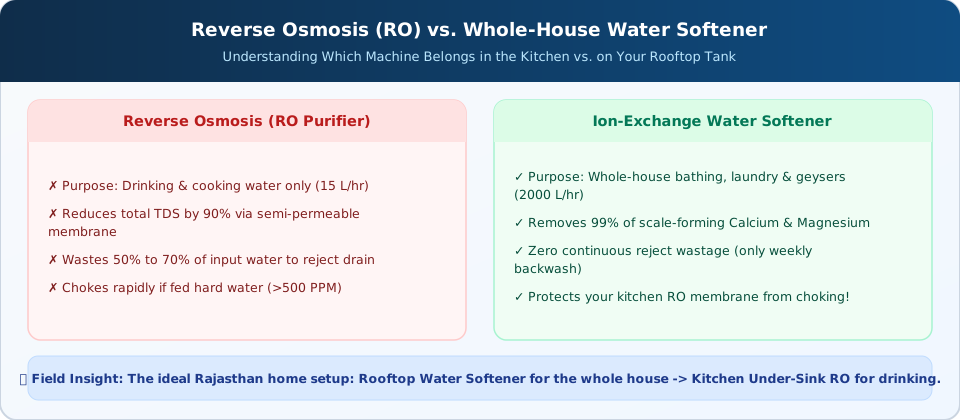
Why You Should Never Use a Rooftop RO for Bathing Water
When homeowners in high-TDS zones like Jagatpura, Sanganer, Ajmer, or Beawar get tired of salty, hard borewell water ruining their hair and clogging geysers, their first instinct is: "Our kitchen RO makes water sweet—why don't we put a big RO on the terrace for the whole house?"
That single mistake costs homeowners lakhs in wasted electricity, burnt high-pressure booster pumps, and massive groundwater depletion. Here is why RO and Water Softeners are engineered for completely different jobs:
1. Water Wastage: 65% Reject vs. 98% Efficiency
An RO system forces water through microscopic membrane pores under high pump pressure. For every 1 liter of purified water it produces, it dumps 1.5 to 2.5 liters of concentrated reject water down the drain. If your family uses 1,500 liters a day for bathing, flushing, and washing clothes, a whole-house RO will waste 3,000 liters of precious groundwater every single day.
An Ion-Exchange Water Softener operates at normal pipeline pressure with zero continuous reject water. Every drop that enters the vessel comes out softened. It only uses ~100 liters of water once a week when regenerating with compacted salt tablets.
RO vs. Water Softener: Complete Engineering Comparison
| Feature | Water Softener (Cation Resin) | Reverse Osmosis (RO System) |
|---|---|---|
| Primary Application | Showers, geysers, washing machines, taps, pools | Drinking water, tea/coffee, cooking |
| Flow Rate | High (1,500 to 10,000+ Liters/Hour) | Slow trickle (12 to 20 Liters/Hour for home units) |
| Electricity Required? | Zero (Manual valve) or 5W timer (Auto valve) | High (Requires booster pump every time it runs) |
| Consumable Needed | 99.7% Pure Salt Tablets (₹500 / 25kg bag) | Membranes, sediment filters, carbon cartridges |
| Media Lifespan | Resin lasts 5 to 8 years when fed pure salt tablets | Membrane chokes in 6–12 months on hard water |
Why Your Kitchen RO Needs a Water Softener Upstream
Do you need both? In Rajasthan, yes—and they work together as a team. When you install a central water softener at your overhead tank, it strips out the scale-forming calcium and magnesium for all your bathrooms and appliances. Then, when that pre-softened water enters your kitchen RO purifier, your RO membrane doesn't get crusted with calcium scale—doubling your RO membrane's lifespan and improving recovery rates.