"When homeowners in Jaipur ask us 'Where does all the white calcium rock go if a softener doesn't have a reject waste pipe running 24/7 like a kitchen RO?', we explain the beauty of Ion Exchange: during the 6 days you use water, zero water is wasted—the resin beads silently trap every calcium and magnesium ion like jutaan tiny magnets, and flush them all out at once during a 60-minute salt-water wash once a week."
The Core Mechanism: Cation Exchange
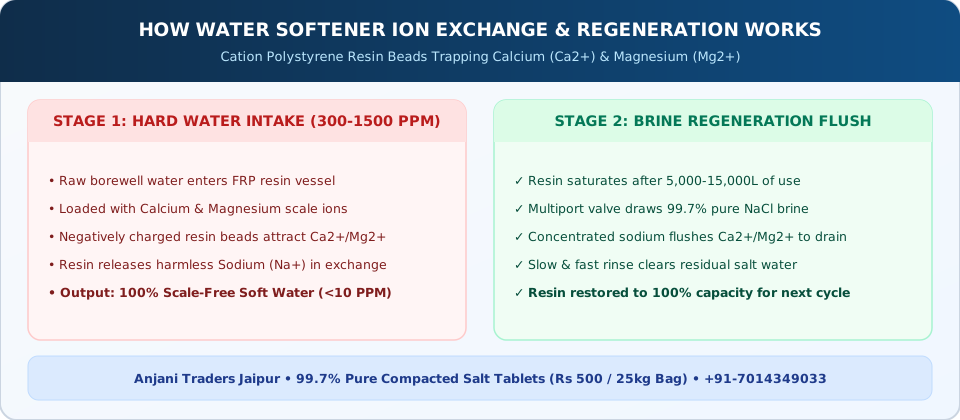
At the heart of every domestic water softener is a simple chemical process called cation exchange. Hard water contains dissolved positive ions (cations) of calcium (Ca²⁺) and magnesium (Mg²⁺). A water softener removes these minerals by swapping them with sodium (Na⁺) or potassium (K⁺) ions, which do not cause scale build-up or interfere with soap lathering.
This exchange takes place inside the main fiberglass tank (mineral cylinder) of the system, which is filled with thousands of tiny, negatively charged plastic beads known as cation exchange resin. These polystyrene beads are pre-charged with sodium ions. Because calcium and magnesium have a stronger positive electrical charge than sodium, they displace the sodium ions and bind tightly to the resin beads as hard water flows through the tank.
The Anatomy of a Water Softener
A typical residential water softener system consists of three main components:
- The Resin Cylinder: A high-pressure tank that houses the cation resin beads where the actual water softening process occurs.
- The Brine Tank: A secondary plastic container that stores a saturated saltwater solution (brine) created by dissolving high-purity water softener salt tablets. This brine is used during the regeneration phase.
- The Control Valve: An automatic or manual multiport valve mounted on top of the resin cylinder. It tracks water flow, determines when the resin is saturated, and handles the flow of water during regeneration.
The Four Stages of Operation
To continuously provide soft water, the system cyclically transitions between service and maintenance stages:
- 1. Service Phase: Hard water enters the resin cylinder, flows downward through the resin bed where calcium and magnesium are captured, and emerges as clean soft water which is distributed throughout the building.
- 2. Backwash Phase: Once the resin beads are saturated with hardness minerals, the control valve reverses the water flow to flush out dirt, sediment, and fractured resin beads through the drain line, loosening the compacted bed.
- 3. Brine Draw & Regeneration: The control valve draws the concentrated brine solution from the salt tank. The high concentration of sodium ions in the brine forces the calcium and magnesium ions off the resin beads, sending them down the drain. The resin is thus recharged with sodium.
- 4. Fast Rinse & Refill: Freshwater flushes out the remaining salt water from the resin cylinder, and the system adds a controlled volume of water back into the brine tank to prepare brine for the next cycle. The valve then switches back to the Service Phase.
Choosing the Right Valve: Automatic vs Manual
Manual softeners require a user to physically turn a multiport valve handle through the backwash, brine, and rinse stages every few days. Automatic softeners, such as premium models from 3M (SFT-100/200) or Ion Exchange (Zero B), use computerized control heads that trigger regeneration automatically based on a set time or volumetric water consumption, ensuring zero manual intervention.
For the best water softening solutions in Jaipur, trust Anjani Traders. We supply premium-grade softeners and Gujarat factory-direct salt tablets to keep your systems running at maximum efficiency.
Why Ion Exchange Beats RO and Magnetic Conditioners for Whole-House Water
To appreciate why ion-exchange softening is the global gold standard for homes, hotels, and industrial boilers across Rajasthan, compare it against the alternatives:
- Zero Daily Water Wastage (Unlike RO): As detailed in our RO vs. Water Softener Comparison, a kitchen RO purifier wastes 60–70% of water continuously and drops pressure to a trickle. An ion-exchange softener delivers full 2,000–3,000 LPH pipeline pressure with 0% wastage during service.
- 100% Physical Removal (Unlike Magnetic Wraps): Unlike electronic/magnetic pipe conditioners that leave calcium inside the water to bake inside geysers, food-grade cation resin physically removes Ca2+ and Mg2+ from the water stream.
- Powered by Pure Salt Brine: During the regeneration cycle, saturated brine made from 99.7% pure compacted salt tablets (₹500 / 25kg bag) recharges the resin beads to 100% capacity.
Frequently Asked Questions
Request Softener Support
Connect with Anjani Traders on WhatsApp for prompt service, salt delivery, or expert advice in Jaipur.