"If you ever unscrew the hot-water braided outlet pipe underneath a geyser in Jagatpura or Mansarovar after two winters of borewell usage, you will see concentric rings of rock-hard white limestone choking a 15mm pipe down to a 3mm pinhole. That happens because calcium bicarbonate is 'reverse-soluble'—unlike sugar or table salt which dissolve faster in hot water, calcium carbonate turns into solid rock the moment water is heated above 55°C."
The Chemistry of Limescale Precipitation
Limescale is primarily composed of calcium carbonate (CaCO₃). In groundwater, calcium exists as dissolved calcium bicarbonate (Ca(HCO₃)₂), which is highly soluble in water. This bicarbonate is held in solution by dissolved carbon dioxide gas. However, this chemical balance is highly sensitive to changes in temperature and pressure.
When hard water is heated—such as inside a geyser, steam boiler, or even as it passes through solar water heater panels—the dissolved carbon dioxide gas escapes. Without the carbon dioxide to stabilize it, the soluble calcium bicarbonate undergoes a thermal breakdown, transforming into insoluble calcium carbonate, water, and carbon dioxide gas:
The insoluble calcium carbonate precipitates out of the water, crystallizing onto the nearest hot surface (like a heating element) or rough surface (like the interior joints of plumbing pipes). Over time, these crystals stack together, forming a hard, rock-like crust.
Why Heating Accelerates Scale
Unlike most chemicals which become more soluble as water temperature increases, calcium carbonate exhibits retrograde solubility. This means it becomes *less* soluble as water gets hotter. As a result, the rate of scale formation accelerates exponentially at higher temperatures. A geyser set to 60°C will accumulate scale twice as fast as one set to 50°C. This is why heating elements are always the first components to burn out in hard water areas.
The Insulating Effect and Energy Loss
Limescale has extremely poor thermal conductivity; it acts as a thermal insulator. When a layer of scale coats a heating element, heat cannot transfer efficiently into the surrounding water. The element must run hotter and longer to heat the water, drastically increasing electricity consumption.
- 1.6 mm of scale reduces heating efficiency by roughly 11% to 15%.
- 3.2 mm of scale leads to a thermal transfer loss of approximately 20% to 25%.
- 6.4 mm of scale can inflate heating utility bills by up to 35% to 40%.
Furthermore, because heat is trapped inside the element, it overheats, fractures, and suffers premature electrical failure.
Preventing Scale Damage
To prevent limescale formation, the hardness minerals must be removed from the water supply before it enters the heating loop. Ion exchange water softeners capture calcium and magnesium, ensuring that the water running through your piping, geysers, and appliances cannot form scale, regardless of temperature.
Anjani Traders offers state-of-the-art water softening solutions designed to handle the severe mineral content of Jaipur's groundwater, protecting your appliances and lowering your utility costs.
Why Rajasthan's Summer Heat & Winter Geysers Accelerate Limescale
In Rajasthan, extreme seasonal temperatures supercharge the thermodynamic precipitation of calcium carbonate (CaCO3) across your entire home:
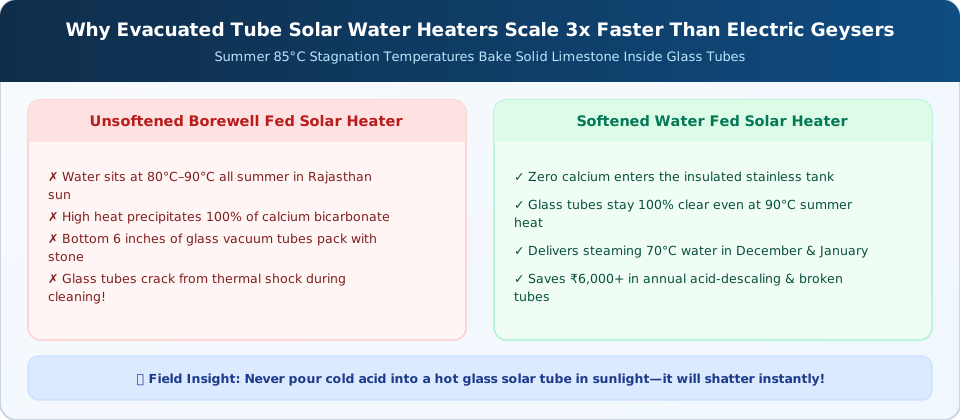
- In Summer (45°C Ambient + 90°C Solar Heaters): Rooftop overhead plastic tanks and exposed terrace pipes heat up in the May–June sun, while evacuated glass-tube solar water heaters reach 85°C–95°C—baking dense calcite crust inside pipes and desert air cooler honeycomb pads.
- In Winter (Electric Geysers & Steam Boilers): Heating 700–1,400 PPM borewell water inside storage geysers and industrial boilers precipitates gram after gram of insulating scale every single day.
Installing a properly sized ion-exchange water softener and regenerating it with 99.7% pure compacted salt tablets (₹500 / 25kg bag) swaps scale-forming Calcium ions for 100% soluble Sodium ions—making limescale precipitation chemically impossible at any temperature.
Frequently Asked Questions
Request Softener Support
Connect with Anjani Traders on WhatsApp for prompt service, salt delivery, or expert advice in Jaipur.